
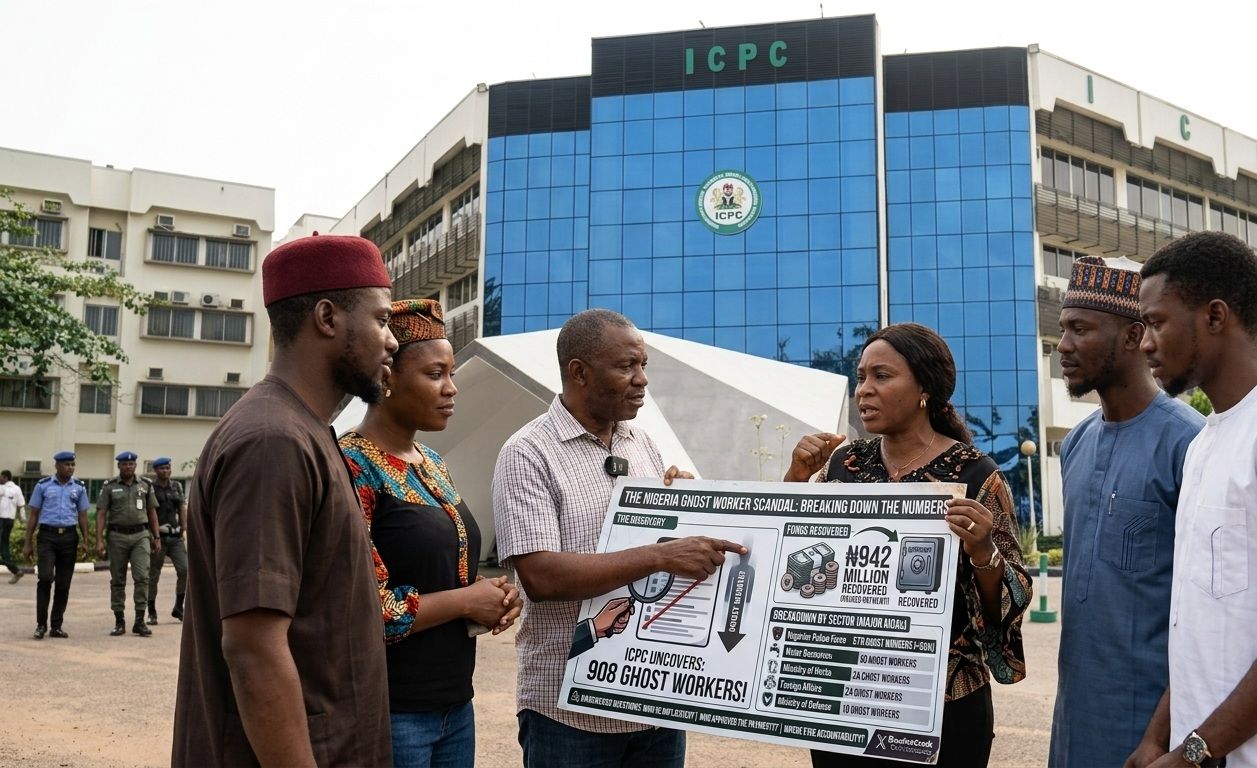
The Independent Corrupt Practices and Other Related Offences Commission (ICPC) says it has uncovered 908 ghost workers across several federal government agencies as part of its ongoing investigation into Nigeria's Integrated Personnel and Payroll Information System (IPPIS).
According to details highlighted in the investigation, the discovery led to the recovery of approximately ₦942 million that was reportedly set to be paid to individuals who do not exist within the government workforce.
The development has renewed public debate about accountability in Nigeria's public service payroll system and raised fresh questions about how ghost workers continue to appear despite years of reforms.
ICPC Expands IPPIS Investigation
The investigation focused on the Integrated Personnel and Payroll Information System, commonly known as IPPIS, a platform designed to manage salary payments for federal government workers.
The system was introduced to improve transparency, eliminate payroll fraud, and ensure that only verified employees receive government salaries.
However, the latest findings suggest that significant loopholes may still exist within parts of the system.
According to the figures presented during the investigation, a total of 908 ghost workers were identified across several Ministries, Departments, and Agencies (MDAs).
The commission's intervention reportedly prevented ₦942 million from being paid out through the payroll process.
Agencies With the Highest Number of Ghost Workers
The investigation provided a breakdown of agencies where ghost workers were discovered.
Nigerian Police Force
The Nigerian Police Force recorded the highest number of ghost workers among the affected agencies.
Key findings include:
- 570 ghost workers identified
- More than half of all ghost workers uncovered during the investigation were linked to the police payroll
The figure represents over 50 percent of the total ghost workers discovered across all agencies mentioned.
Other Affected Agencies
The investigation also identified ghost workers in several other federal institutions:
| Agency | Number of Ghost Workers |
|---|---|
| Nigerian Police Force | 570 |
| National Water Resources Authority | 80 |
| Federal Ministry of Works | 56 |
| Ministry of Foreign Affairs | 24 |
| Ministry of Defense | 19 |
These figures show that the issue cuts across multiple sectors of government administration.
Questions Nigerians Are Asking
Beyond the headline figures, the discussion surrounding the investigation focused heavily on accountability.
While the agencies involved were identified, no individual names were mentioned in relation to the alleged payroll fraud.
This has led to several questions being raised:
Who Benefited?
One of the major concerns is determining who actually benefited from the salaries allocated to non-existent workers.
Ghost workers do not create themselves within a payroll system. Their existence usually requires someone to enter, approve, or maintain false records.
How Long Did the Payments Continue?
Another question centers on the duration of the alleged fraud.
If ghost workers were identified in the system, Nigerians are asking how long the payments had been occurring before the discovery.
The answer could help determine the full financial impact on public resources.
Who Approved the Payments?
The payroll process involves multiple levels of oversight.
Questions have been raised about:
- Who approved the records
- Who verified employee data
- Who authorized salary payments
- Whether existing controls failed or were deliberately bypassed
Will Anyone Be Held Responsible?
Perhaps the most significant question is whether any officials will face consequences.
Calls have emerged for authorities to identify those responsible and ensure that sanctions, disciplinary measures, or prosecutions follow where necessary.
A Familiar Problem in Nigeria's Public Sector
The issue of ghost workers is not new in Nigeria.
During the discussion, reference was made to a previous discovery in Jigawa State in 2014.
According to the example cited, the state reportedly uncovered 6,348 ghost workers, a situation said to have cost approximately ₦3.7 billion.
The reference was used to illustrate that ghost worker schemes have remained a recurring challenge despite repeated efforts by governments at different levels to clean up payroll systems.
Many anti-corruption initiatives have focused on biometric verification, digital payroll management, and personnel audits, yet discoveries continue to emerge years later.
Why the Discovery Matters
The recovery of ₦942 million goes beyond a financial figure.
Every naira allocated to a ghost worker represents money that could have been used for:
- Infrastructure projects
- Healthcare services
- Educational programs
- Security operations
- Social welfare initiatives
When payroll funds are diverted to non-existent employees, legitimate government workers and citizens ultimately bear the cost.
The discovery also raises concerns about public confidence in government institutions and financial management systems.
Growing Demand for Transparency
The discussion surrounding the investigation emphasized that citizens have a right to know how public funds are managed.
Many Nigerians believe anti-corruption efforts should not end with announcing figures and recoveries.
Instead, they argue that investigations should answer critical questions, including:
- Who created the ghost worker records?
- Who approved them?
- Who received the money?
- What actions have been taken against those involved?
Advocates of stronger accountability insist that transparency is necessary if public trust is to be restored.
Without clear consequences, concerns remain that similar schemes could reappear in the future.
Author: https://Houseinnasarawa.com